

If you have ever opened your Texas appraisal notice and seen two or three different dollar amounts next to your home, you are not alone. Market value, appraised value, and taxable value are not the same number, and understanding what separates them is one of the most useful things a homeowner can learn before deciding whether to look into property tax protest services.
This guide breaks down each term in plain English, walks through a simple example with real numbers, and explains why lowering your market value can still matter even when a cap is already limiting your appraised value.
What Is Market Value?
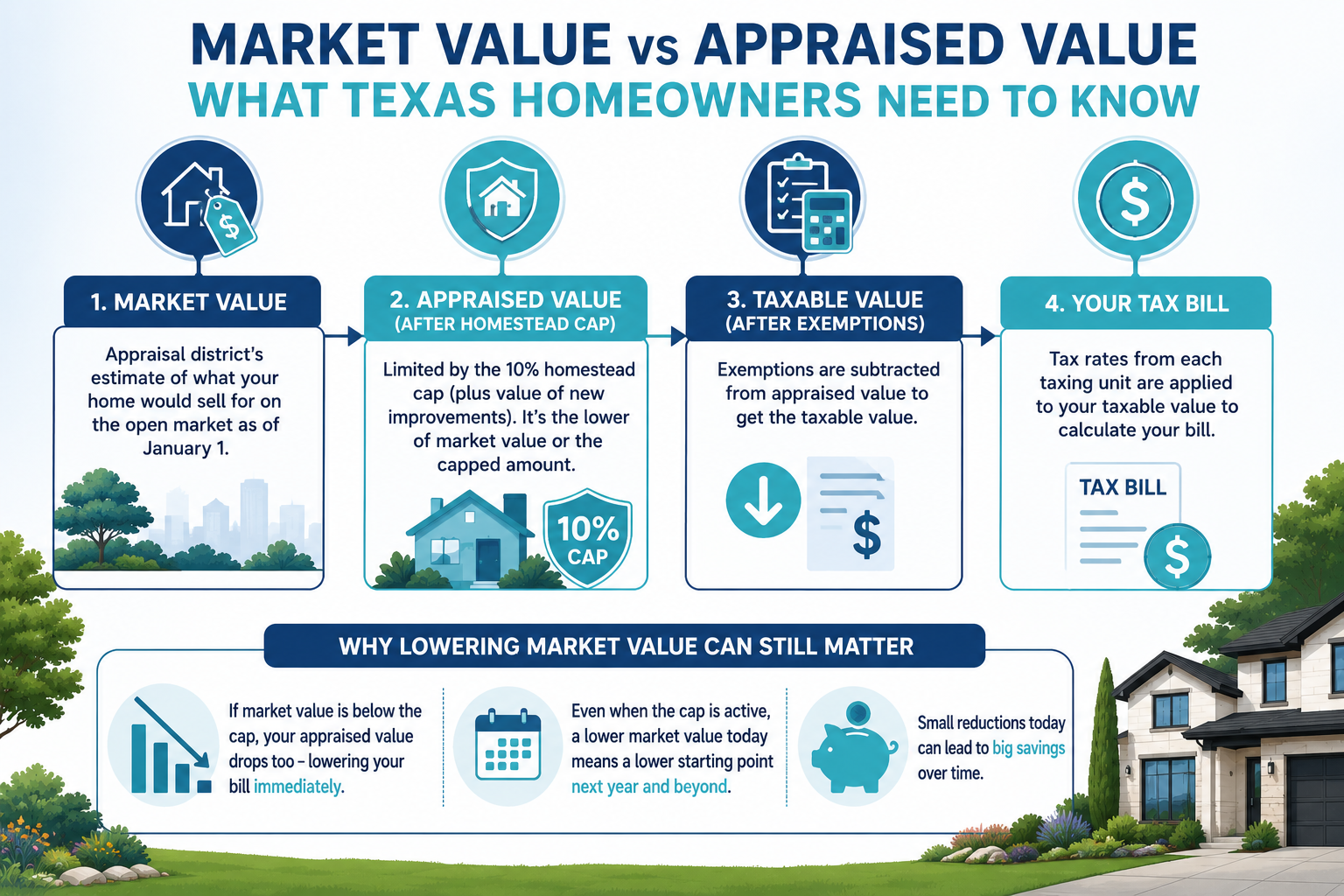
Market value is your county appraisal district’s estimate of what your home would sell for on the open market as of January 1 of the tax year. It is based on recent sales of similar homes in your area, along with your home’s size, condition, and features.
Market value is meant to reflect reality. If homes like yours in your neighborhood have been selling for around $450,000, your appraisal district’s market value estimate will typically land somewhere close to that number.
This is the starting point for everything else on your appraisal notice. If market value looks too high compared to what similar homes nearby have actually sold for, that mismatch is usually the first thing worth questioning before you look at any other number on the page.
What Is Appraised Value, and Why It May Differ From Market Value
Appraised value is the number your appraisal district actually uses to calculate your taxes, and it is not always the same as market value. For homes with a homestead exemption, Texas law limits how much the appraised value can increase each year, even if the market value jumps higher.
This limit is often called the homestead cap, and it generally allows your appraised value to rise by no more than 10 percent per year, plus the value of any new improvements, compared to the previous year’s appraised value.
So while market value tracks what the appraisal district believes your home is actually worth, appraised value is the lower of that market value or the capped number allowed under the homestead limit. When the market is rising quickly, these two numbers can end up looking quite different on your notice.
What Is Taxable Value After Exemptions?
Once your appraised value is set, exemptions are applied to bring it down to your taxable value, which is the number your tax bill is actually calculated from.
The most common exemption is the general residence homestead exemption, which reduces the appraised value used for school district taxes by a set dollar amount. Other exemptions may apply too, including those for homeowners age 65 or older, homeowners with a qualifying disability, or veterans, depending on eligibility.
Different taxing units, such as your school district, city, and county, can apply different exemption amounts, which means your taxable value can vary slightly depending on which part of your bill you are looking at.
A Simple Example With Numbers
Here is how these terms work together for a typical Texas homestead.
Say your home had an appraised value of $400,000 last year. This year, based on recent sales, your appraisal district sets your market value at $450,000.
Because your home has a homestead exemption, the 10 percent cap limits how much your appraised value can rise this year. Ten percent of $400,000 is $40,000, so your appraised value this year is capped at $440,000, even though market value came in higher at $450,000.
From there, your school district homestead exemption is subtracted from that appraised value to arrive at your taxable value for school taxes. If your exemption reduces the value by $140,000, your taxable value for school district purposes becomes $300,000.
Your actual tax bill is then calculated by applying your local tax rates to that taxable value, not to the market value or the uncapped appraised value. This is why two homes with similar market values can end up with noticeably different tax bills, depending on how long each owner has held their homestead exemption and how the cap has built up over the years.
Why Lowering Market Value Can Still Matter, Even With a Cap
It is tempting to assume that if the cap is already limiting your appraised value, protesting market value will not make a difference. That is not necessarily true.
If your market value comes in below what the 10 percent cap would otherwise allow, your appraised value drops to match that lower market value instead. In that situation, the cap simply is not doing any work, and a successful protest lowers your bill directly.
Even when the cap is actively limiting your appraised value, a lower market value still matters for the future. Next year’s cap calculation starts from this year’s appraised value, so a lower starting point this year can mean a lower ceiling next year, and the year after that. Over several years, that difference can add up.
This is one of the reasons homeowners across Texas, including fast-growing areas around Houston, continue to review their market value every year rather than assuming the cap is doing all the work for them.
Appraisal Notices and Tax Bills Use Different Terms
One source of confusion is that your appraisal notice and your tax bill do not always use identical language. Your appraisal notice typically shows market value and appraised value side by side, along with any exemptions on file.
Your tax bill, on the other hand, focuses on taxable value and the tax rates set by each taxing unit that applies to your property. It generally will not repeat the market value discussion found on your notice.
Knowing which document you are looking at, and which number matters for which purpose, makes it much easier to understand whether a protest is worth pursuing and what kind of difference it might make.
Why This Matters When You Protest
Understanding these terms is not just academic. When you protest, you are almost always challenging the market value your appraisal district has assigned, since that is the number the appraised value and taxable value are ultimately built from.
This is where tax protest consultants and a property tax protest service Texas homeowners trust can help clarify which number is worth focusing on for your specific situation, especially when a cap is already in play and it is not immediately obvious how much a lower market value would actually help.
SaveOnHouseTaxes.com works with homeowners to review appraisal notices, pull together evidence, and pursue a protest with a clear understanding of how market value, appraised value, and taxable value connect. Because SaveOnHouseTaxes.com operates on a contingency basis, homeowners only pay if the protest results in tax savings, so there is no upfront cost to find out whether a lower market value would make a real difference on your bill.
Final Thoughts
Market value, appraised value, and taxable value each play a different role on your Texas appraisal notice and tax bill, and knowing how they connect helps you make sense of the numbers instead of just guessing. Whether your appraised value is currently capped or tracking right along with market value, reviewing your notice each year is worth the time.
If the terminology still feels confusing or you are not sure whether your numbers are accurate, property tax protest services can walk through your specific notice with you and help you understand exactly where your money is going.
FAQ
Q. What is the difference between market value and appraised value in Texas?
Market value is your appraisal district’s estimate of what your home would sell for. Appraised value is the number actually used to calculate taxes, and for homestead properties it is the lower of market value or the amount allowed under the 10 percent annual cap.
Q. Why is my appraised value lower than my market value?
If you have a homestead exemption, Texas law limits how much your appraised value can rise each year, generally to 10 percent plus the value of new improvements, even if market value increases faster.
Q. What is taxable value?
Taxable value is your appraised value after exemptions, such as the general residence homestead exemption, have been subtracted. It is the number your tax rate is actually applied to.
Q. If my value is already capped, is it still worth protesting?
Often, yes. If market value is below the capped amount, the cap is not limiting anything and a lower market value reduces your bill directly. Even when the cap is active, a lower market value this year can lower the starting point for future years.
Q. Do all exemptions reduce my value by the same amount?
No. Different taxing units, such as school districts, cities, and counties, can apply different exemption amounts, so your taxable value may vary slightly depending on which part of your tax bill you are reviewing.
Q. Does SaveOnHouseTaxes.com charge anything upfront?
No. SaveOnHouseTaxes.com works on a contingency basis, so homeowners only pay if the protest results in tax savings.