

Getting a lower appraised value feels like the finish line, but your actual tax bill is still a few steps away. Understanding how the result of your protest connects to that eventual bill is something property tax protest services spend real time explaining, since the two numbers are related but not identical.
This guide walks through the difference between your appraisal result and your tax bill, why the final number can differ from an earlier estimate, and what to check once your bill actually arrives.
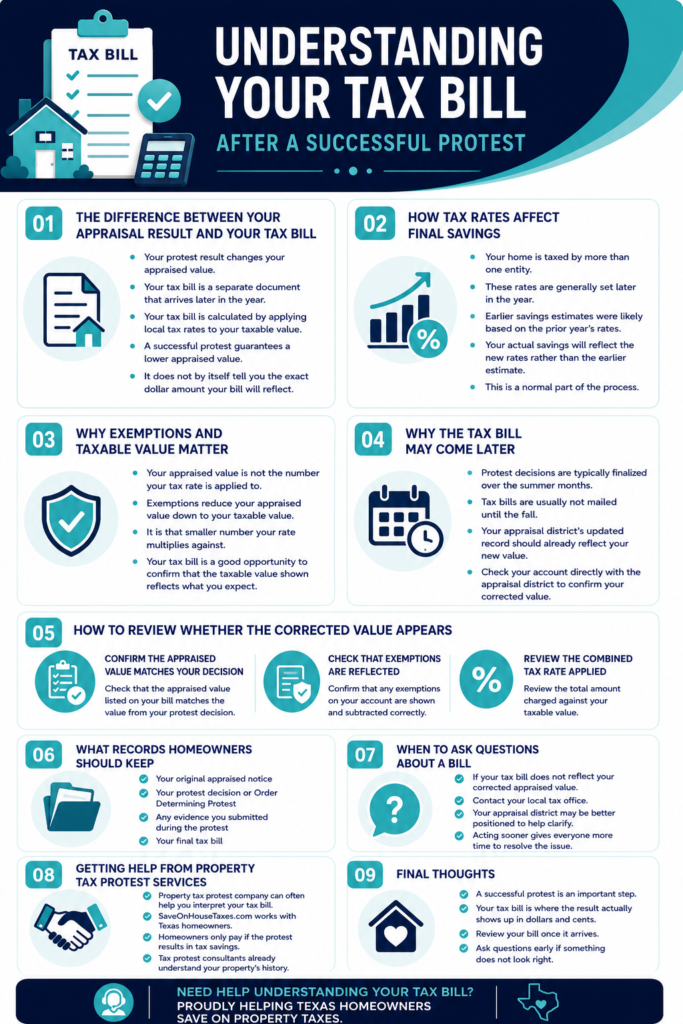
The Difference Between Your Appraisal Result and Your Tax Bill
Your protest result changes your appraised value, which is the number your appraisal district assigns to your property. Your tax bill is a separate document that arrives later in the year, calculated by applying local tax rates to your taxable value, which is your appraised value after any exemptions.
These are two different documents prepared by different offices. Your appraisal notice and protest decision come from your county appraisal district. Your tax bill comes from your local tax office once all the taxing units in your area have set their rates for the year. A successful protest guarantees a lower appraised value. It does not by itself tell you the exact dollar amount your bill will reflect, since that depends on rates that may not be finalized yet at the time of your decision.
How Tax Rates Affect Final Savings
Your home is taxed by more than one entity, typically a school district, city, county, and sometimes additional taxing units like a municipal utility district. Each sets its own rate, and together these rates make up your combined tax rate.
These rates are generally set later in the year, often after protest season has wrapped up. This means any savings estimate you received around the time of your protest was likely based on the prior year’s rates, since current year rates were not yet available. If rates move up or down from the previous year, your actual savings will reflect the new rates rather than the earlier estimate.
This is a normal part of the process, not a sign that anything went wrong. It simply reflects the fact that your appraised value and your tax rates are determined on different timelines.
Why Exemptions and Taxable Value Matter
Your appraised value is not the number your tax rate is actually applied to. Exemptions, such as the general homestead exemption, reduce your appraised value down to your taxable value, and it is that smaller number your rate multiplies against.
If your exemptions were already accurate before your protest, your reduced appraised value should carry through to a correspondingly lower taxable value. If there was ever a question about whether an exemption was properly applied, your tax bill is a good opportunity to confirm that the taxable value shown reflects what you expect, since an exemption issue can affect your bill independently of anything related to your protest.
Why the Tax Bill May Come Later
Protest decisions are typically finalized over the summer months, but tax bills are usually not mailed until the fall, once every taxing unit in your area has adopted its rate for the year. This gap can feel long if you are eager to see your savings reflected somewhere official.
In the meantime, your appraisal district’s updated record should already reflect your new value, even before your tax bill arrives. If you want to confirm your corrected value before the bill shows up, checking your account directly with the appraisal district is generally the fastest way to see it.
How to Review Whether the Corrected Value Appears
Once your tax bill arrives, take a few minutes to review it against your protest result rather than assuming everything transferred correctly.
Confirm the Appraised Value Matches Your Decision
Check that the appraised value listed on your bill matches the value from your protest decision, not the original number from your initial notice.
Check That Exemptions Are Reflected
Confirm that any exemptions on your account are shown and subtracted correctly to arrive at your taxable value.
Review the Combined Tax Rate Applied
While you may not be able to verify each individual taxing unit’s rate without additional research, reviewing the total amount charged against your taxable value can help you sense check whether the bill looks reasonable compared to your expectations.
What Records Homeowners Should Keep
A simple set of records makes this review much easier and gives you something to reference if a question comes up later.
- Your original appraisal notice showing the initial value
- Your protest decision or Order Determining Protest showing the corrected value
- Any evidence you submitted during the protest
- Your final tax bill once it arrives
Keeping these together, whether in a physical folder or a digital file, means you are not searching for scattered documents if a discrepancy needs to be resolved.
When to Ask Questions About a Bill
If your tax bill does not reflect your corrected appraised value, or if the numbers on it do not make sense compared to your protest decision, that is worth following up on rather than assuming it will sort itself out.
Contacting your local tax office, which handles billing, is usually the right first step if the appraised value itself looks wrong on the bill, since that would suggest the correction did not carry through properly. If your question is more about how exemptions or the calculation works, your appraisal district may be better positioned to help clarify.
Acting on these questions sooner rather than later gives everyone more time to resolve the issue before payment deadlines approach.
Getting Help From Property Tax Protest Services After Your Bill Arrives
If you worked with a property tax protest company to pursue your reduction, that same team can often help you interpret your tax bill once it arrives, since they already have context on your specific case.
SaveOnHouseTaxes.com works with Texas homeowners, including many across the Houston area, not just through the protest itself but also in helping homeowners understand what their result means once the tax bill actually arrives. Because SaveOnHouseTaxes.com operates on a contingency basis, homeowners only pay if the protest results in tax savings, and that same relationship can make it easier to get a straight answer if your bill raises any questions.
Tax protest consultants who already understand your property’s history are often better positioned to spot something that looks off than someone starting from scratch when your bill shows up months later.
Final Thoughts
A successful protest is an important step, but your tax bill is where the result actually shows up in dollars and cents. Understanding that your appraised value and your tax rates are set on different timelines, confirming your exemptions carried through correctly, and reviewing your bill against your protest decision all help you make sense of the final number.
Whether you handled your protest yourself or worked with property tax protest services, taking a few minutes to review your bill once it arrives is worth the time, and asking questions early if something does not look right is always a reasonable next step.
FAQ
Q. Is my appraised value the same as my tax bill?
No. Your appraised value is set by your appraisal district. Your tax bill is a separate document calculated by applying local tax rates to your taxable value, which comes later in the year.
Q. Why did my actual savings differ from an earlier estimate?
Earlier estimates are often based on the prior year’s tax rates, since current rates are usually not finalized until later in the year, after your protest decision.
Q. When will I receive my tax bill after a successful protest?
Tax bills are typically mailed in the fall, once local taxing units have adopted their rates, while protest decisions are usually finalized over the summer.
Q. What should I check when my tax bill arrives?
Confirm the appraised value matches your protest decision, verify your exemptions are reflected correctly, and review the total amount against your expectations.
Q. What should I do if my bill does not reflect my corrected value?
Contact your local tax office if the appraised value itself looks wrong, or your appraisal district if your question involves exemptions or calculations.
Q. Does SaveOnHouseTaxes.com help after the tax bill arrives?
Yes. SaveOnHouseTaxes.com can help homeowners understand their tax bill after a protest, and operates on a contingency basis, so homeowners only pay if the protest results in tax savings.