

If you have been hearing that the housing market has cooled off, but your appraisal notice still shows a higher value, you are not imagining things. This is one of the more common sources of confusion homeowners run into, and it is also one of the reasons property tax protest services spend so much time explaining how appraisal timing actually works.
This guide walks through why a broader market slowdown does not always show up on your specific notice, and how to evaluate whether your number is actually accurate.
Broad Market Headlines Versus Local Neighborhood Data
News coverage about the housing market usually reflects national or regional trends, averaged across a huge number of transactions. A headline describing a slower market statewide, or even across a large metro area like Houston, can be entirely accurate while still not reflecting what happened in your specific neighborhood.
Appraisal districts do not value your home based on national trends. They rely on actual sales data from properties near you, sometimes down to a specific subdivision or school zone. If homes in your immediate area continued selling at strong prices even while broader headlines described a slowdown, your appraised value can reflect that local reality rather than the bigger picture.
This gap between broad narrative and local data is one of the most common reasons homeowners feel blindsided by a notice that seems to contradict what they have been reading or hearing. It is not that the headlines are wrong. It is that they are describing a much larger area than the one your specific home sits in.
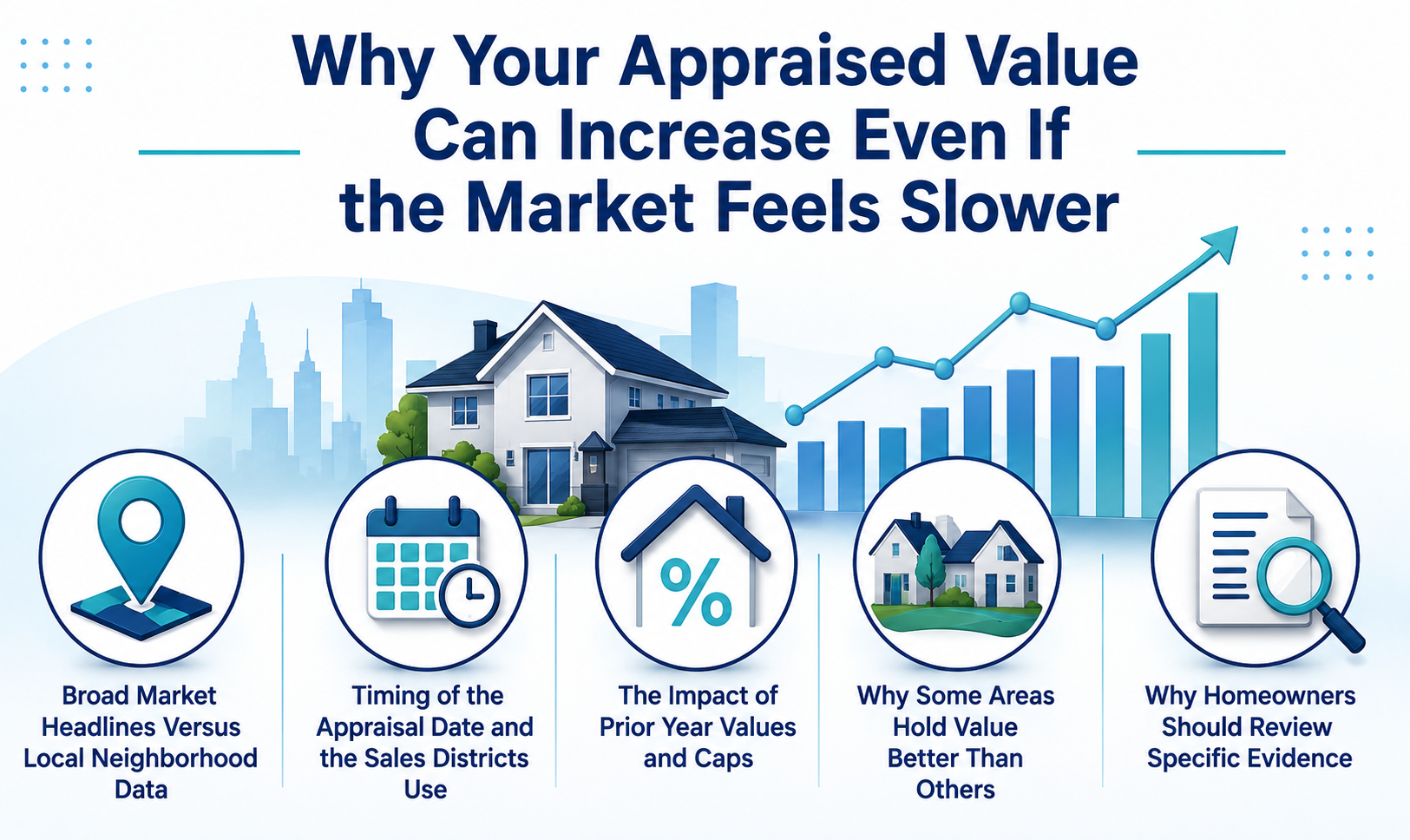
Timing of the Appraisal Date and the Sales Districts Use
Texas appraisal districts value property as of January 1 of each tax year. That valuation is typically based on sales data collected over the prior months, sometimes stretching back further, depending on how much recent sales activity is available in your area.
This creates a natural lag. If the market began cooling in the months right before your notice was prepared, that shift may not be fully reflected yet, since the district’s data still includes the stronger sales that came before the slowdown. Conversely, if your area had a late surge in sales activity before the appraisal date, that strength can show up in your value even if things have since leveled off.
Understanding this timing helps explain why your notice can feel out of step with more recent market chatter. The number you are looking at is a snapshot built from a specific window of past sales, not a live read of today’s conditions.
The Impact of Prior Year Values and Caps
For homes with an active homestead exemption, your appraised value this year is also shaped by last year’s number and the 10 percent homestead cap, not just current market conditions. If your appraised value was capped below market value last year, this year’s number can still rise toward that market ceiling even if the market itself has slowed, simply because the cap is catching up.
This means an increase on your notice does not automatically mean your appraisal district thinks your home’s value went up this year. It can also reflect your value gradually catching up to where the market already was, based on the cap mechanics working through prior years.
Why Some Areas Hold Value Better Than Others
Even within the same broader market, neighborhoods can perform quite differently. Areas with strong school ratings, limited new construction, or particular buyer demand can hold or increase in value even during a period when other parts of the same metro area soften.
This is true across Texas generally, including within the Houston area, where some neighborhoods can see continued price strength while others cool more noticeably. A citywide or statewide headline simply cannot capture this level of variation, which is part of why relying on your specific neighborhood’s data matters more than a general market narrative.
Why Homeowners Should Review Specific Evidence
Given all of this, the most reliable way to evaluate your notice is to look at actual data for your specific property and neighborhood, rather than relying on a general sense of how the market feels.
Start With Recent Comparable Sales
Look at homes similar to yours in size, age, and condition that have sold recently near you. If those sales support a lower number than your appraised value, that is meaningful evidence. If they support the value on your notice, that is useful information too, even if it is not what you were hoping to see.
Check for Condition Issues
If your home has condition issues that a buyer would factor into an offer, documenting them remains relevant regardless of what the broader market is doing.
Compare to Last Year's Number
Understanding whether this year’s increase is driven by new market data or simply the cap catching up to an already higher market value can change how you interpret the notice.
How to Respond Without Assuming the Value Is Automatically Wrong
It is natural to feel frustrated when a notice increases during a period that felt slower overall, but that frustration alone is not evidence one way or the other. The appraised value on your notice may be accurate for your specific property, even if it does not match the general narrative you have been hearing.
The most productive response is to treat the increase as a prompt to check the actual data, rather than an automatic sign of a mistake. Sometimes that review confirms the value makes sense. Other times it turns up a real gap worth addressing.
Finding Property Tax Protest Services That Understand Your Local Market
A protest tends to make the most sense when your review of comparable sales, unequal appraisal comparisons, or condition issues turns up a genuine gap between your appraised value and what the actual local data supports, not simply because the value increased during a period that felt slower.
If your research supports your case, property tax protest services can help present that evidence clearly, whether at an informal review or a formal ARB hearing. A property tax protest service Texas homeowners trust can also help interpret whether an increase reflects genuine market movement in your specific area or simply a cap catching up to an already established market value.
SaveOnHouseTaxes.com works with Texas homeowners, including many across the Houston area, to review appraisal notices against actual local data rather than general market impressions. Because SaveOnHouseTaxes.com operates on a contingency basis, homeowners only pay if the protest results in tax savings, so there is no upfront cost to find out whether your specific notice supports a protest.
Final Thoughts
A rising appraised value during a period that feels slower is not necessarily a mistake, and it is not necessarily correct either. It depends on what actually happened in your specific neighborhood, when your value was measured relative to recent sales, and how prior year values and caps are affecting this year’s number.
Working with property tax protest services or reviewing the data yourself, the goal is the same either way: understand what the actual evidence for your property shows, rather than assuming your notice must be wrong simply because the broader market headlines told a different story.
FAQ
Q. Why did my appraised value go up if the market is supposedly slowing down?
Broad market headlines describe large areas, while your appraisal district uses local sales data specific to your neighborhood. The two can move differently at the same time.
Q. What date does my appraisal district use to value my home?
Texas appraisal districts value property as of January 1 of each tax year, based on sales data collected over the prior months.
Q. Can a homestead cap make my value rise even in a slow market?
Yes. If your value was capped below market value last year, it can rise toward that ceiling this year simply because the cap is catching up, independent of current market conditions.
Q. Does an increase automatically mean the value is wrong?
Not necessarily. The most reliable way to know is to check actual comparable sales and evidence for your specific property rather than assuming based on general market impressions.
Q. When does it make sense to protest an increased value?
When your review of comparable sales, unequal appraisal comparisons, or condition issues shows a genuine gap between your appraised value and the local data, not simply because the value increased.
Q. Does SaveOnHouseTaxes.com charge anything upfront to review my notice?
No. SaveOnHouseTaxes.com works on a contingency basis, so homeowners only pay if the protest results in tax savings.