

Montgomery County has grown substantially over the past decade, and that growth shows up clearly on homeowners’ appraisal notices each year. Whether you live in Conroe, Spring, The Woodlands, or one of the county’s many newer communities, understanding property tax protest in Montgomery County helps you evaluate your notice with more confidence instead of just accepting the number as final.
This guide walks through why appraisal changes deserve a close look here, how local growth affects values differently across the county, and what to expect if you decide to protest.
Why Montgomery County Homeowners Should Review Appraisal Changes
Montgomery County has consistently ranked among the faster growing counties in Texas, with new subdivisions, commercial development, and population growth reshaping large parts of the area. That kind of sustained growth tends to push appraised values upward, sometimes more quickly than homeowners anticipate from one notice to the next.
A higher value on your notice does not automatically mean something was calculated incorrectly. It often reflects genuine demand in your area. Still, reviewing the specific numbers on your notice every year, rather than assuming the appraisal district got it exactly right, remains one of the more useful habits any Montgomery County homeowner can build.
This is true whether you have owned your home for one year or twenty. Even long time owners in stable neighborhoods can see a larger than expected jump if nearby growth has picked up recently, which is part of why an annual check makes sense regardless of how long you have lived in your home.
Local Growth and Neighborhood Differences
Montgomery County is not one uniform market, and treating it that way can lead to misunderstanding your own notice.
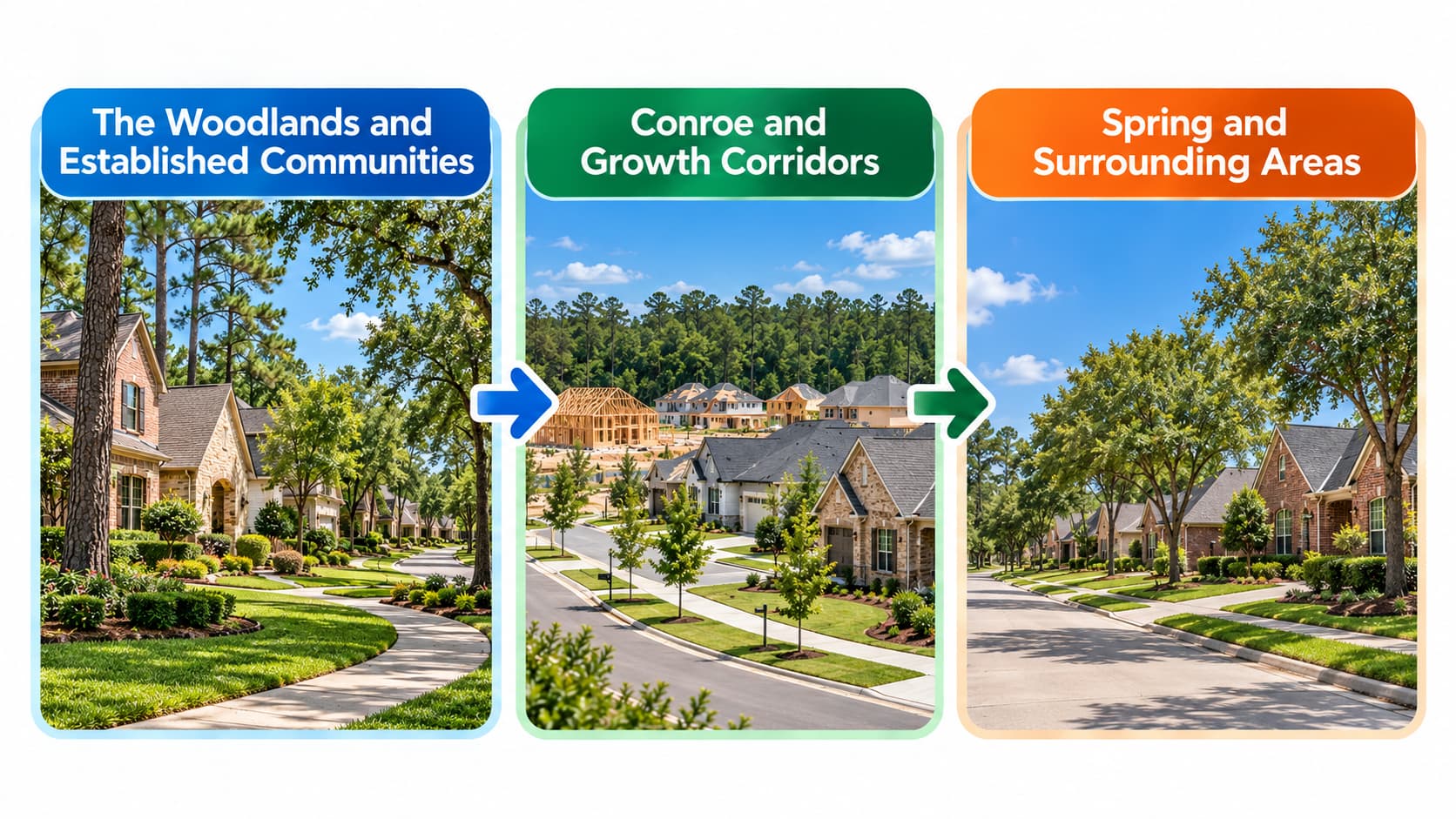
The Woodlands and Established Communities
Areas like The Woodlands have long been known for strong demand and limited available land for new development. Home values in these more established communities can behave differently than in areas still actively expanding, since the supply of comparable homes is more limited.
Conroe and Growth Corridors
Conroe and the surrounding growth corridors have seen substantial new construction in recent years. In these areas, recent sales of newly built homes can influence how appraisal districts view nearby older properties, even when the comparison is not perfectly apples to apples.
Spring and Surrounding Areas
Communities around Spring sit at the intersection of established neighborhoods and continued suburban growth, which means appraised values here can reflect a mix of factors depending on how close a given home is to newer development.
Because these dynamics vary block by block in some cases, relying on neighborhood specific data, rather than assuming a countywide trend applies evenly, gives you a more accurate picture of your own situation.
What to Know About Property Tax Protest in Montgomery Before You File
The overall protest process in Montgomery County follows the same general framework used across Texas, administered locally through the county’s appraisal district.
In most years, the deadline to file a protest falls on May 15, or 30 days after your notice was mailed, whichever is later, though the specific date printed on your notice is always the number that actually applies to your account. Once a protest is filed, cases typically move toward an informal review first, with a formal ARB hearing available if the disagreement is not resolved at that stage.
Because forms, portal names, and specific procedures can be updated from year to year, confirming current requirements directly with the appraisal district before filing is always worth the extra few minutes.
Evidence That May Support a Lower Value
The evidence that tends to work well in Montgomery County protests mirrors what applies across Texas generally, with some local considerations worth keeping in mind.
Comparable sales remain one of the more persuasive types of evidence, particularly when they reflect homes similar in age, size, and condition within the same general area, whether that is a specific section of The Woodlands, a Conroe subdivision, or a neighborhood near Spring. Because some parts of the county are still actively developing, prioritizing recent sales over older data tends to produce a more accurate comparison.
Unequal appraisal comparisons, which look at appraised value per square foot relative to similar nearby homes, can also help, especially in newer areas where traditional sales comparisons may be limited. Documentation of condition issues, supported by photos and repair estimates, remains relevant regardless of which part of the county you live in.
What Happens After a Protest Is Filed
Once filed, your protest typically moves toward scheduling, first for an informal review and, if needed, a formal ARB hearing. Given the county’s growth, hearing volume during peak season can be significant, so some patience with scheduling is often necessary.
If your case resolves informally, you may see a decision relatively quickly. If it proceeds to a formal hearing, expect a more structured process, generally involving a scheduled time slot and a panel reviewing evidence from both sides before making an independent decision.
Whatever the outcome, the resulting appraised value becomes the basis for your tax bill once local tax rates are set later in the year. Keeping a copy of your protest filing and any decision you receive is a simple habit that makes future years easier to track.
How SaveOnHouseTaxes.com Can Help Homeowners Stay Organized
Between fast changing neighborhoods, evolving comparable sales data, and the general demands of daily life, keeping up with a protest in a growing county like Montgomery takes real effort. For many homeowners, that is exactly where outside help becomes useful.
Homeowners researching the best property tax protest companies Montgomery County has to offer often want the same basic things: a clear process, responsive communication, and evidence gathering that actually reflects current local conditions rather than outdated data.
SaveOnHouseTaxes.com works with homeowners throughout the Houston area, including Montgomery County, helping review appraisal notices, organize supporting evidence, and stay on top of deadlines through the informal review and, if needed, a formal ARB hearing. Because SaveOnHouseTaxes.com operates on a contingency basis, homeowners only pay if the protest results in tax savings, so there is no upfront cost to have your notice reviewed.
Whether you are comparing tax protest companies in Montgomery for the first time or considering a change from a previous provider, understanding the local factors at play helps you evaluate any option, including handling the process yourself, with more clarity.
Why You Should Verify Local Details
Because Montgomery County’s growth means procedures and appraisal district resources can be updated more frequently than in slower changing areas, this guide intentionally avoids stating specific portal names, exact forms, or precise dates. Your county appraisal district remains the most reliable source for the current requirements that apply to your specific property.
Final Thoughts
Property tax protest in Montgomery County is worth approaching with a clear understanding of how local growth, neighborhood differences, and evidence quality all interact. Whether you live near The Woodlands, in Conroe, around Spring, or anywhere else in the county, reviewing your appraisal notice every year and confirming current deadlines with your appraisal district puts you in a stronger position no matter which path you choose.
Whether you handle your protest yourself or bring in help to stay organized through the process, treating your appraisal notice as worth a real look each year is one of the more reliable habits a Montgomery County homeowner can build.
FAQ
Q. Why do appraised values keep rising in Montgomery County?
Sustained population growth, new subdivisions, and commercial development have pushed demand and appraised values up across much of the county, though the pace varies by neighborhood.
Q. Do The Woodlands, Conroe, and Spring see the same value trends?
Not necessarily. Established areas like The Woodlands, growth corridors around Conroe, and mixed communities near Spring can each see different appraisal patterns based on local development and available land.
Q. What is the deadline to protest in Montgomery County?
In most years the deadline is May 15 or 30 days after your notice was mailed, whichever is later. Always confirm the exact date printed on your specific notice.
Q. What evidence works best for a Montgomery County protest?
Recent comparable sales specific to your neighborhood, unequal appraisal comparisons, and documented condition issues tend to be the most useful evidence types.
Q. Should I compare multiple property tax protest companies in Montgomery?
It can help to ask about fee structure, communication, and evidence gathering before choosing, rather than comparing companies on price alone.
Q. Does SaveOnHouseTaxes.com charge anything upfront?
No. SaveOnHouseTaxes.com operates on a contingency basis, so homeowners only pay if the protest results in tax savings.