

That envelope from your county appraisal district can feel easy to set aside, especially if you are busy or the number inside looks confusing. But a few focused minutes with your notice now can make a real difference later, and it is the first step for anyone considering a property tax protest in Houston or anywhere else in Texas.
This guide walks through exactly what to check on your notice, what deadlines to look for, and how to decide whether to protest on your own or bring in help.
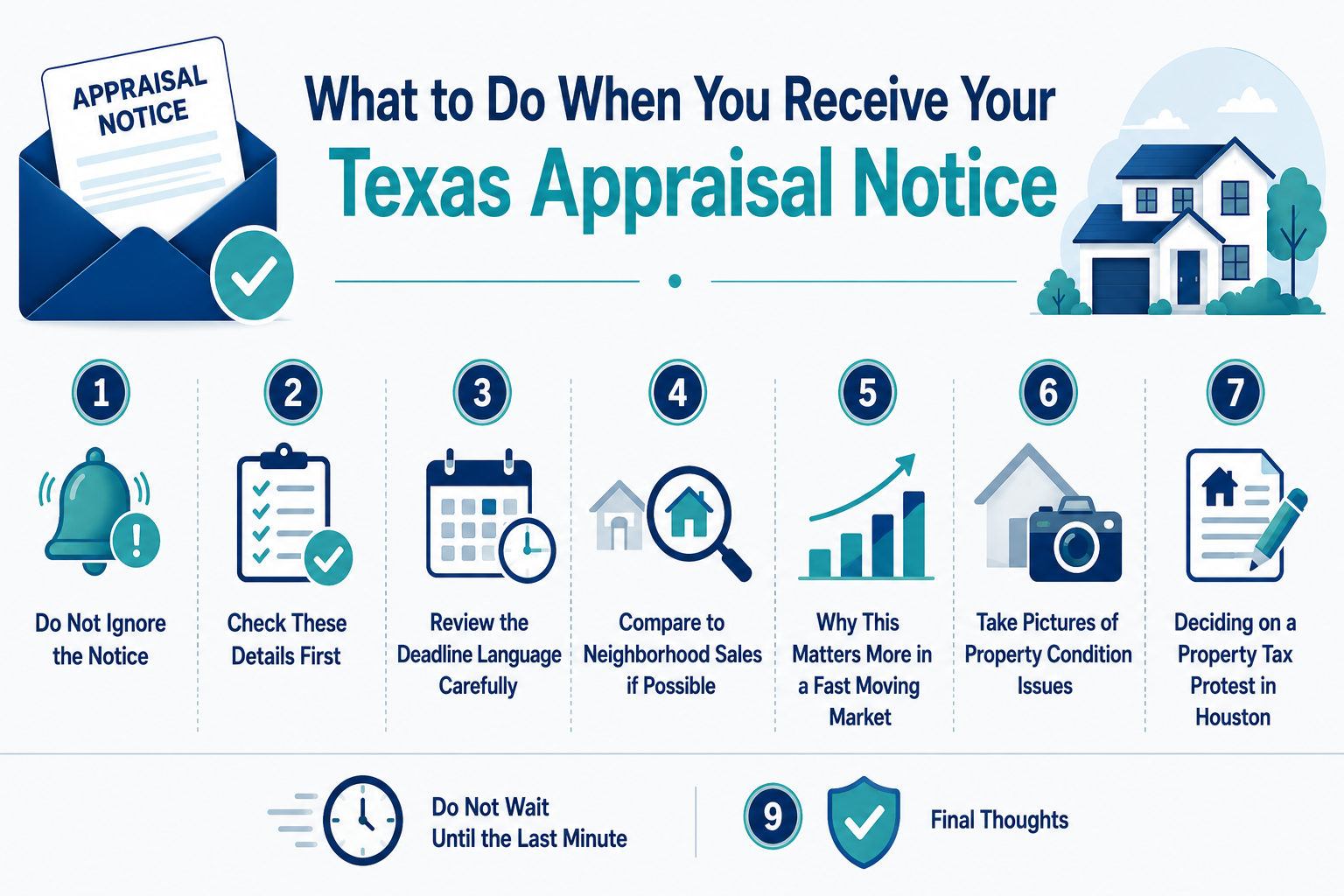
Do Not Ignore the Notice
It is tempting to toss the notice in a drawer, especially if your mortgage escrow account handles your tax payments automatically. But your appraisal notice is not a bill. It is a statement of value, and it comes with a deadline attached.
If you miss that deadline, you generally lose the chance to challenge your value for the entire year, even if the number turns out to be wrong. Opening the notice the same week it arrives, rather than weeks later, gives you the most time to review it and decide what to do next.
Check These Details First
Before you decide anything, take a few minutes to confirm the basic information on the notice is accurate.
Owner Name and Property Address
Start with the simple stuff. Confirm your name is spelled correctly and the property address matches your home. Errors here are not common, but they do happen, and they are worth catching early.
Exemptions
Look for the exemptions listed on your notice, including your general homestead exemption if you live in the home as your primary residence. If an exemption you expected is missing, that is worth following up on right away, since exemptions directly reduce your taxable value.
Market Value and Appraised Value
Your notice will show your market value, which is the appraisal district’s estimate of what your home would sell for, and your appraised value, which is the number actually used to calculate your taxes. For homes with a homestead exemption, these two numbers are not always the same.
Prior Year Value
Most notices also show last year’s value next to this year’s. Comparing the two tells you how much your value moved and gives you a starting point for deciding whether the increase makes sense given what has happened in your neighborhood.
Review the Deadline Language Carefully
Every notice includes a deadline to file a protest if you disagree with the value. In most years, that deadline falls on May 15 or 30 days after the notice was mailed, whichever is later, but the exact date printed on your notice is what actually applies to your account.
Read this section closely rather than assuming you know the date from a prior year or a general rule of thumb. Appraisal districts across Texas, including here in the Houston area, print the specific deadline directly on the notice for a reason.
Compare to Neighborhood Sales if Possible
Once you know your value, it helps to get a sense of whether it lines up with reality. Look at recent sales of similar homes near you, meaning homes of a similar size, age, and condition in your neighborhood.
If homes like yours have been selling for noticeably less than your new appraised value, that is a signal worth paying attention to. You do not need a formal appraisal to do this kind of initial check. Real estate listing sites, county sales records, and conversations with neighbors who have recently sold can all give you a rough sense of where the market actually sits.
For example, if your appraised value jumped to $410,000 this year but three similar homes on your street sold for between $370,000 and $385,000 over the past several months, that gap is worth documenting. It does not guarantee a lower value once you protest, but it gives you a concrete starting point instead of a general feeling that the number seems high.
Why This Matters More in a Fast Moving Market
In neighborhoods across the Houston area, home values can shift quickly from one year to the next. A round of new construction, a handful of high sale prices, or general market momentum can push appraised values up faster than the actual condition of any individual home would justify.
That is not a reason to assume every notice is wrong. Plenty of increases reflect real market movement. But it is a reason to actually look at the numbers each year instead of assuming last year’s review still applies, especially if your neighborhood has seen a lot of recent activity.
Take Pictures of Property Condition Issues
If your home has issues that could affect its value, foundation problems, roof damage, outdated systems, or anything else that a buyer would factor into an offer, take clear photos now while the notice deadline is still in front of you.
Condition issues are easy to forget about day to day, but they matter when it comes to explaining why your home might be worth less than the appraisal district’s estimate. Photos dated close to the notice date carry more weight than vague descriptions pulled together later.
Deciding on a Property Tax Protest in Houston
Once you have reviewed the basics, compared your value to nearby sales, and gathered any condition photos, you are in a position to decide what to do next.
Some homeowners choose to file and handle the protest themselves. Others prefer to bring in property tax protest services, especially when time is tight or the process feels unfamiliar. Working with tax protest consultants can be useful if you would rather have someone else manage deadlines, prepare evidence, and represent you at a hearing.
SaveOnHouseTaxes.com works with homeowners across the Houston area who want that kind of support. The process starts with a review of your notice, then moves into gathering evidence and filing on your behalf if a protest makes sense. Because SaveOnHouseTaxes.com operates on a contingency basis, homeowners only pay if the protest results in tax savings, so reviewing your notice with a professional costs nothing upfront.
Do Not Wait Until the Last Minute
Whichever path you choose, act early. Waiting until the week of the deadline leaves little room to gather evidence, compare sales, or get help if you decide you want it.
Homeowners looking into property tax protest Houston options tend to have better results when they start the process as soon as the notice arrives rather than scrambling in the final days. Appraisal districts see a wave of last minute filings every year, and starting early simply gives you more room to work with.
Final Thoughts
Your Texas appraisal notice is worth a close look the moment it arrives, not weeks later when the deadline is close. Checking your basic information, understanding your market and appraised value, comparing to nearby sales, and documenting any condition issues all put you in a stronger position.
Whether you decide to handle it yourself or pursue a property tax protest in Houston with professional help, the most important step is simply not letting the notice sit unopened until it is too late to act.
FAQ
Q. What should I check first when I get my Texas appraisal notice?
Start with your owner name, property address, exemptions, market value, appraised value, and last year’s value. Confirming these details takes just a few minutes and tells you whether anything looks off.
Q. What is the deadline to protest my property taxes?
In most years the deadline is May 15 or 30 days after your notice was mailed, whichever is later. The exact date is printed on your notice, so always check that instead of relying on a general rule.
Q. Do I need to protest every year?
You are not required to, but reviewing your notice every year is worth the time, since market conditions and appraised values can change annually.
Q. What if I do not respond to the notice at all?
If you do not file a protest by the deadline, you generally lose the right to challenge that year’s value, even if it turns out to be inaccurate.
Q. Should I handle my protest myself or get help?
Either approach is reasonable. Some homeowners prefer to handle the process themselves, while others bring in property tax protest services to manage deadlines, evidence, and hearings on their behalf.
Q. Does SaveOnHouseTaxes.com charge anything upfront?
No. SaveOnHouseTaxes.com works on a contingency basis, so homeowners only pay if the protest results in tax savings.