

Once your hearing is over, whether it was an informal review or a formal ARB hearing, the waiting is not quite finished. Understanding what comes next is just as important as the hearing itself, especially for anyone tracking a Houston property tax appeal through to the end.
This guide walks through how results are typically communicated, what a reduced or unchanged value actually means, and what to keep on hand once the decision is final.
How Results Are Communicated
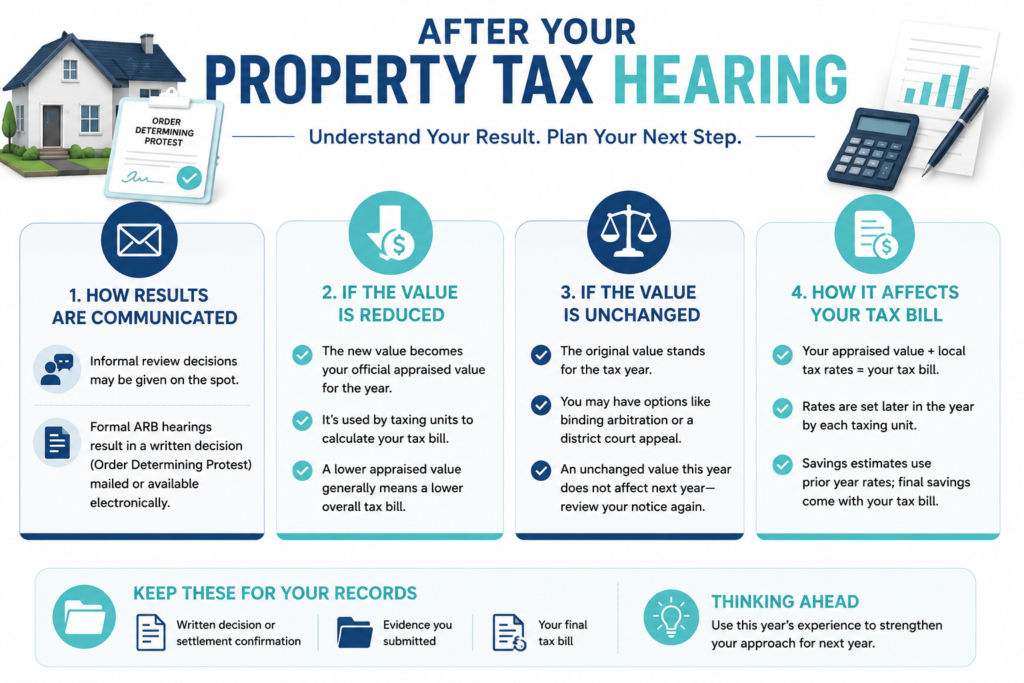
After an informal review, you may receive a decision on the spot, since the appraiser has some ability to agree to an adjusted value during the conversation itself. If the case moves to a formal ARB hearing instead, the panel typically issues a written decision rather than announcing it immediately in the room.
This written decision is usually called an Order Determining Protest. It is generally mailed or made available electronically, depending on the appraisal district, and it states the final value the ARB has determined for your property.
Keep an eye on both mail and any online account you may have set up with your appraisal district, since some districts default to electronic delivery once you have registered.
What It Means if the Value Is Reduced
If your protest results in a lower value, the new number becomes your official appraised value for the year. This is the figure your local taxing units will use when calculating your tax bill.
A reduction does not necessarily mean every part of your bill drops by the same percentage, since different taxing units apply different rates and exemptions. Still, a lower appraised value generally means a lower overall bill compared to what you would have paid at the original number.
It is worth reviewing the decision carefully to confirm the new value matches what was discussed or presented during your hearing. Occasionally, minor discrepancies happen, and catching them early is easier than trying to correct them later.
If you notice anything that does not match what you expected, contacting your appraisal district promptly is the most reliable way to sort out the discrepancy while the details of your case are still fresh.
What It Means if the Value Is Unchanged
If the ARB decides to keep the original appraised value, that number stands for the tax year. This does not mean your evidence was wrong or that the process failed. Appraisal review boards weigh evidence from both sides, and sometimes the panel determines the original value is supported.
If you disagree with the outcome, Texas law generally allows further options, such as binding arbitration or an appeal to state district court, depending on your situation. These paths involve additional cost, time, and specific requirements that go beyond a first-time protest, so it is worth thinking carefully about whether pursuing them makes sense for your circumstances.
Either way, an unchanged value this year does not lock in future years. Reviewing your notice again next year remains worthwhile, since market conditions and appraised values can shift from one year to the next.
How the Result Connects to Your Tax Bill
Your appraised value, whether reduced or unchanged, feeds directly into your property tax bill later in the year. Local taxing units, including school districts, cities, and counties, set their tax rates separately, generally later in the calendar year, and apply those rates to your taxable value.
This means your final bill depends on both your appraised value and the tax rates set by each taxing unit, not on the appraised value alone. A reduced appraised value generally lowers your bill, but the exact dollar amount depends on the rates in effect once they are finalized.
If your mortgage escrow account handles your property taxes, any change should be reflected automatically once your servicer receives the updated tax bill, though it is still worth confirming the correct value was applied. If you pay your property taxes directly rather than through escrow, keeping an eye out for your official bill later in the year is especially important so you can verify the reduced or unchanged value carried through correctly.
When Savings Are Estimated Versus Finalized
It is common to see an estimated savings figure discussed during or after a protest, especially if you worked with property tax protest services. That estimate is generally based on the prior year’s tax rates applied to your new appraised value, since actual rates for the current year are not always set yet at the time of your hearing.
Your actual savings are not finalized until your tax bill is issued later in the year, once local taxing units have set their rates. If rates change from the prior year, actual savings can differ somewhat from an earlier estimate, even though the appraised value reduction itself is already final.
What to Keep for Your Records
Once your case is resolved, hold onto a few key documents.
- Your Order Determining Protest or written decision, if you had a formal hearing
- Any settlement confirmation from an informal review
- The evidence you submitted, including comparable sales, photos, or repair estimates
- Your final tax bill once it arrives later in the year
Keeping these together in one place makes it easier to reference your case in future years, especially if a similar situation comes up again or if you want to compare this year’s outcome to prior years.
When Future Protest Strategy May Matter
A single year’s result can offer useful context for future protests, even if this year’s outcome was not what you hoped for. If certain evidence worked well, or if a particular argument did not land the way you expected, that experience can inform how you approach next year’s notice.
For homes with a homestead exemption and an active appraisal cap, a lower appraised value this year can also affect the starting point for next year’s cap calculation, which is one more reason a reduction can matter even beyond the current tax year.
Homeowners who work with tax protest companies Houston area residents rely on often find it helpful to keep the same team involved year over year, since a consistent approach can build on what was learned from previous cases rather than starting from scratch each season.
Getting Help With Your Houston Property Tax Appeal
If you are unsure what your hearing result actually means for your bill, or you want help deciding whether to pursue further options after an unchanged value, property tax protest services can walk through the specifics with you.
SaveOnHouseTaxes.com works with homeowners throughout the Houston property tax appeal process, from filing through the hearing decision, and can help homeowners understand exactly what a result means going forward. Because SaveOnHouseTaxes.com operates on a contingency basis, homeowners only pay if the protest results in tax savings, so there is no upfront cost to get clarity on your specific outcome.
Final Thoughts
The hearing itself is not quite the finish line. Understanding how your result was communicated, what it means for your tax bill, and what to keep for your records helps you close out the process with confidence, whatever the outcome.
Whether your Houston property tax appeal ended in a reduced value, an unchanged value, or something in between, taking a few extra minutes to understand what happens next puts you in a stronger position heading into next year.
FAQ
Q. How will I find out the result of my protest?
Informal reviews can sometimes be resolved on the spot. Formal ARB hearings typically result in a written decision, often called an Order Determining Protest, mailed or made available electronically depending on your appraisal district.
Q. What happens if my value is reduced?
The new value becomes your official appraised value for the year and is used to calculate your tax bill, generally resulting in a lower overall bill compared to the original number.
Q. What happens if my value stays the same?
The original value stands for the tax year. Depending on your situation, further options such as binding arbitration or a district court appeal may be available, though these involve additional cost and requirements.
Q. When will I know my actual tax savings?
Actual savings are not finalized until your tax bill is issued later in the year, once local taxing units set their tax rates. Earlier estimates are generally based on the prior year’s rates.
Q. What documents should I keep after my hearing?
Keep your written decision or settlement confirmation, the evidence you submitted, and your final tax bill once it arrives, so you have a complete record for future reference.
Q. Does SaveOnHouseTaxes.com charge anything upfront?
No. SaveOnHouseTaxes.com works on a contingency basis, so homeowners only pay if the protest results in tax savings.